Best places to live on the Costa Blanca North: an honest comparison
There’s no single best town on the Costa Blanca North. There’s the one that fits how you want to live. Altea and Albir suit people who want the sea within walking distance and a hospital twenty minutes away. Calpe and Jávea have the sandiest beaches and the highest prices. La Nucía and Polop are cheaper and quieter, but inland. Benidorm has everything, including the crowds. Here they are side by side, with official figures.

- Foreign residents range from about a third of the population (La Nucía, Polop, Benidorm) to more than half (Alfaz del Pi, Calpe, Teulada-Moraira), according to INE figures for 1 January 2025.
- Hospital: Altea, Albir, Alfaz del Pi, La Nucía, Polop and Benidorm use the Marina Baixa hospital in La Vila Joiosa, 10 to 18 km away. Calpe, Jávea and Moraira use the hospital in Dénia.
- Prices in October 2026 go from about €2,730/m² in La Nucía to over €4,400/m² in Jávea and Teulada-Moraira.
- Tourist pressure is highest in Calpe, where about 11% of homes are tourist lets, and in Benidorm, with its hotel volume. It’s lowest in La Nucía.
The towns side by side
I’ve used the same sources for every town so they can be compared fairly: INE for population and tourist lets, the Generalitat for the health department each town belongs to, road distances measured on the map, and RealAdvisor’s October 2026 price averages.
| Main beach | Foreign residents (2025) | Public hospital, by road | Avg. price (Oct 2026) | Homes that are tourist lets (May 2026) | |
|---|---|---|---|---|---|
| Altea | Pebble and gravel | 39% | Marina Baixa, 18 km | €4,002/m² | 5.5% |
| Albir / Alfaz del Pi | Pebble | 50% | Marina Baixa, 15 km | €3,627/m² | 3.9% |
| Calpe | Fine sand | 54% | Dénia, 31 km | €4,200/m² | 11.3% |
| La Nucía | Inland | 32% | Marina Baixa, 16 km | €2,730/m² | 0.6% |
| Polop | Inland | 32% | Marina Baixa, 18 km | €3,443/m² | 2.0% |
| Benidorm | Fine sand | 35% | Marina Baixa, 10 km | €3,859/m² | 4.2% |
| Jávea | Coves and gravel; one sand beach | 47% | Dénia, 13 km | €4,417/m² | 9.0% |
| Moraira (Teulada) | Sand and small coves | 56% | Dénia, 29 km | €4,428/m² | 9.2% |
Albir belongs to the municipality of l’Alfàs del Pi, and Moraira to Teulada, so their population and price figures are for the whole municipality. Prices are averages that mix flats, villas, sea views and inland plots, so treat them as a level, not a valuation.
Altea: a real town, with pebble beaches
Altea is a town of about 24,700 people that lives all year, not just in summer. Foreign residents are 39%, a lower share than its neighbours, and the British are a small part of that: under 4% of the population. You’ll hear Spanish, Valencian and many other languages, which suits people who want to integrate rather than live in a bubble.
The beaches are pebble and gravel, and four of them have a Blue Flag in 2026. If you dream of soft sand, that matters. The centre and the old town are walkable, though hilly, and the Marina Baixa hospital is 18 km by road.
At €4,002/m² on average it’s one of the dearer towns. If you’re weighing up parts of Altea, I’ve compared Altea Old Town and Altea la Vella with measured distances.
Albir and Alfaz del Pi: the most international, close to everything
L’Alfàs del Pi has the inland village of Alfaz and the coastal district of Albir. Half its residents are foreign nationals, and about 9% are British, the highest share of the Marina Baixa towns in this comparison. It’s the most international place on this stretch of coast, and day-to-day life in English is easy here.
Albir’s beach is pebble, with a promenade and the Serra Gelada natural park at one end. The hospital is 15 km away, the shortest distance after Benidorm, and the average price, €3,627/m², is below Altea and Calpe. Only 3.9% of homes are tourist lets, so it stays residential outside August.
We’re based here, so I know it best: see our pages for Albir and Alfaz del Pi.
Calpe: sandy beaches, high rises and the most tourist lets
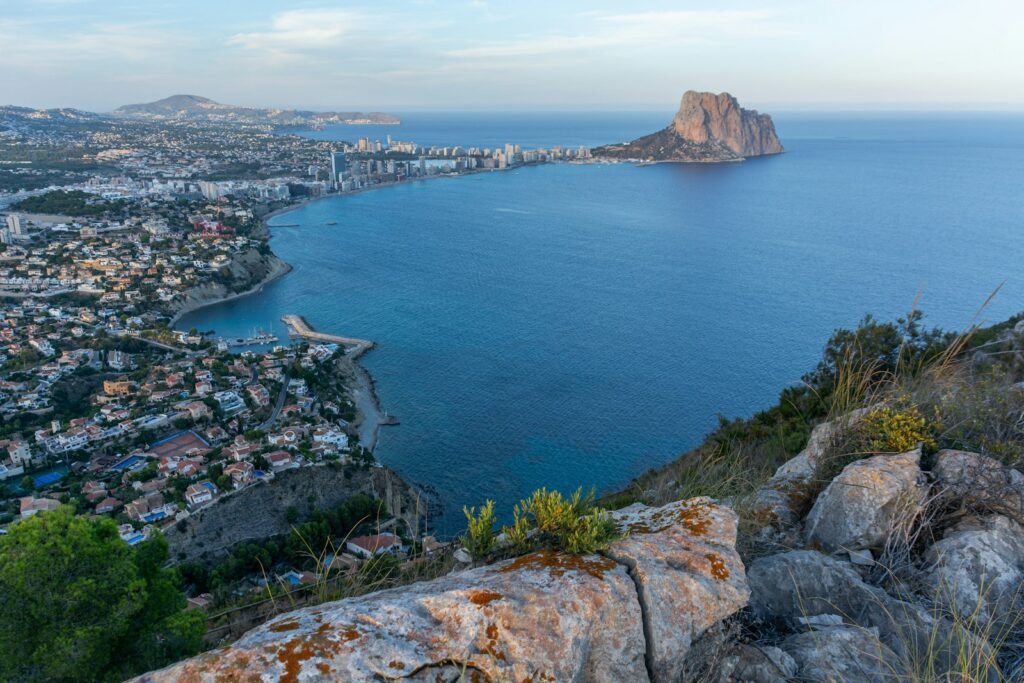
Calpe has what Altea and Albir don’t: long sandy beaches, with five Blue Flags in 2026, and the Peñón de Ifach as the backdrop. Foreign residents are 54% of the population.
Two things to weigh. First, Calpe has the highest share of tourist lets of any town here, 11.3% of all homes, so many blocks near the beach change neighbours every week in season. Second, it belongs to the Dénia health department, and the hospital there is 31 km away, the same distance as Marina Baixa. Prices average €4,200/m².
La Nucía and Polop: cheaper, quieter, inland
Both towns are in the hills behind Benidorm and Altea, with no beach of their own. That’s the trade-off: La Nucía is the cheapest town in this comparison at €2,730/m², and Polop averages €3,443/m². Tourist lets are almost absent in La Nucía (0.6% of homes) and low in Polop (2%).
About a third of residents are foreign in both. Polop is a small town of under 6,000 people; La Nucía has about 19,000. The hospital is 16 to 18 km away. You’ll need a car for almost everything, so think about that if you’re planning to stay for many years.
Benidorm: everything close, including the crowds
Benidorm is the big town of the area, with about 77,000 residents and the closest hospital, 10 km away. Its two main beaches are fine sand, and you can live there entirely on foot.
The other side is tourism on an industrial scale. In August 2026 Benidorm’s 138 hotels recorded over 1.3 million overnight stays. Some areas are lively until late, others are calm and residential. Choosing the street matters more here than anywhere else. The average is €3,859/m².
Jávea and Moraira, briefly
Further north, in the Marina Alta, these are two of the most British places on the coast: about 15% of Jávea’s residents and 17% of Teulada-Moraira’s are UK nationals. They’re also the dearest in this comparison, at over €4,400/m².
Jávea’s coast is mainly coves and gravel beaches, with one sand beach, the Arenal. Both rely on the Dénia hospital, 13 km from Jávea and 29 km from Moraira. Around 9% of homes in each are tourist lets.
The figures for tourist lets tell you how much a place changes with the season. Before you choose, spend a few days in your shortlist in winter. Some streets that are full in August are half shuttered in January.
How to choose
- The sea on foot and a short drive to hospital: Albir and Altea.
- Sandy beaches: Calpe or Benidorm, accepting more tourism.
- Budget and peace: La Nucía or Polop, with a car.
- The largest British community: Jávea and Moraira, at the highest prices.
For retirement, put the hospital distance and whether you can live without a car near the top of the list. Those two matter more at 75 than at 60.
If you’re moving from the UK, the paperwork comes before the house: read up on visas, healthcare and the TIE first. When you’re ready to look, see the homes we have for sale.
We’re based in l’Alfàs del Pi and work in Albir, Altea, Polop and La Nucía, with buyers from all over Europe.
Frequently asked questions
Which town on the Costa Blanca North has the most British residents? +
Teulada-Moraira (about 17% of residents) and Jávea (about 15%), followed by l’Alfàs del Pi, including Albir (about 9%). Figures from INE for 1 January 2025.
Where is the hospital for Altea and Albir? +
The Marina Baixa hospital in La Vila Joiosa, about 18 km by road from Altea and 15 km from Albir.
Which town is cheapest? +
Of those compared, La Nucía, at an average of €2,730/m² in October 2026. It’s inland, so you’ll need a car for the beach.
Does Altea have sandy beaches? +
Its main beaches are pebble and gravel. For fine sand nearby, Calpe and Benidorm are the closest options.
Founder of maXcasa International. Thirty years buying and selling homes on the Costa Blanca North, with clients from all over Europe.
Meet Max →